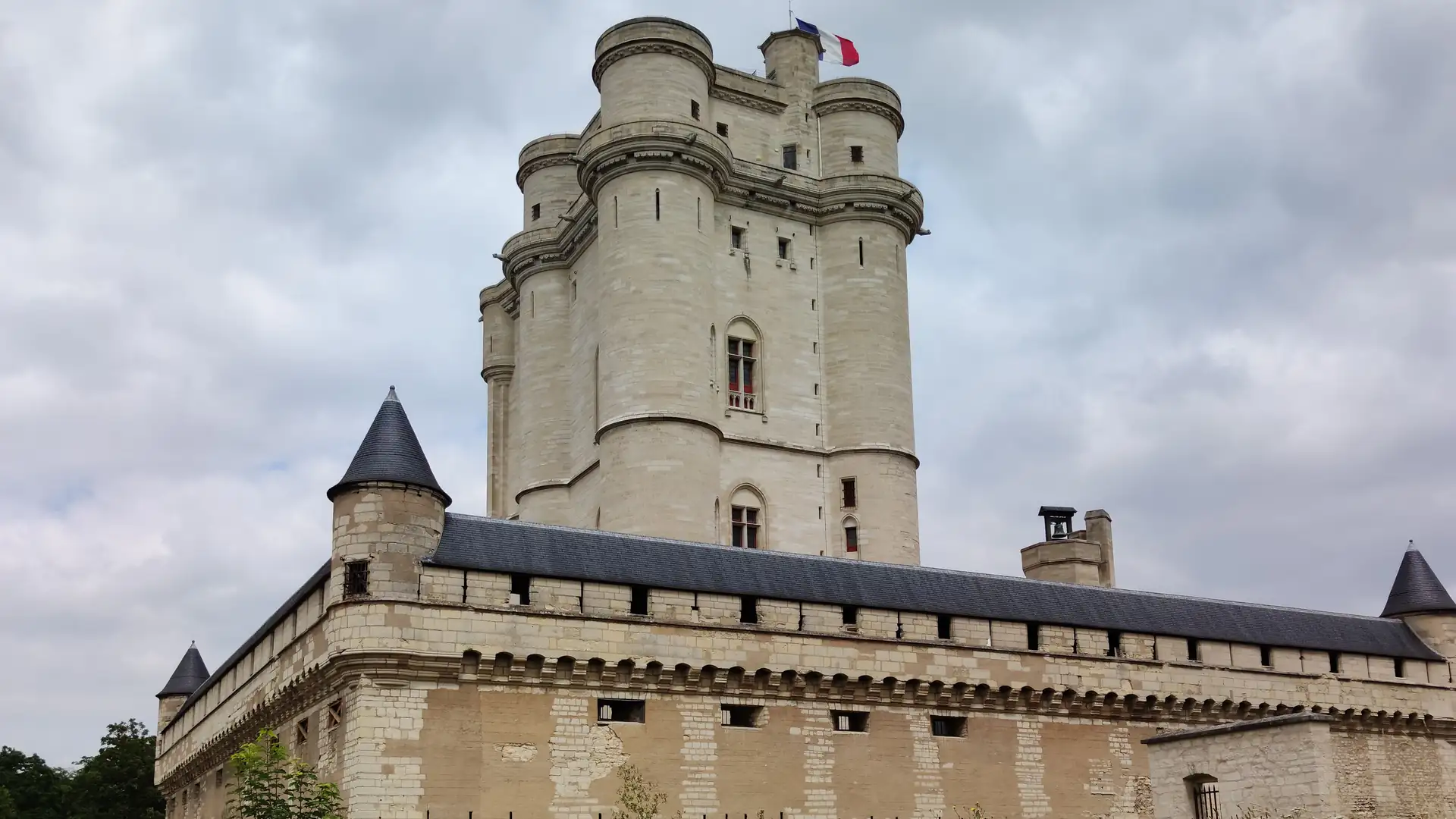
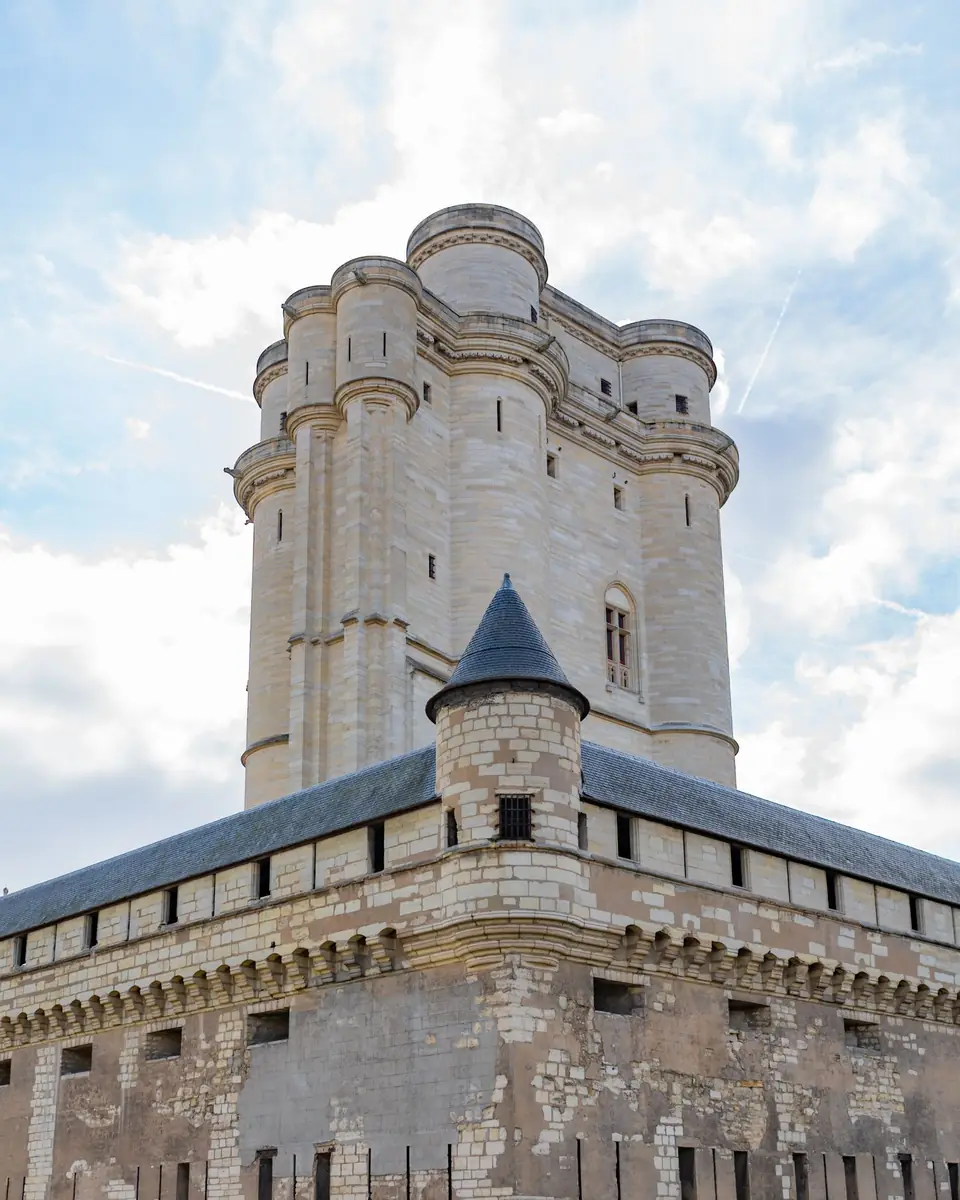
The donjon, floor by floor
The keep is why people come. Charles V moved into it in 1367 or 1368, while it was still being built, and made it a fortified seat of government as much as a tower: a place for his council, his household and, when Paris turned dangerous, himself.
- Ground floor
Wells and a great fireplace
The lowest floor holds wells and the remains of a large fireplace. It was probably used by royal servants, and was largely rebuilt when the keep later served as a prison.
- First floor
The council chamber
The room where the king's council met and where banquets were held, under ribbed vaults; some of its original oak panelling, cut between 1367 and 1371, is still in place.
- Second floor
The king's chamber
Charles V's bedroom fills the central room of this floor, about 100 square metres, its vault ribs picked out in gilded fleurs-de-lis on a blue ground made with lapis lazuli. The same floor held his chapel, his wardrobe and a study where he kept art objects and manuscripts.
- Third floor
Rooms for the royal circle
The plan repeats the floor below without its ornament. The château's own history describes it as reserved for members of the royal family; other accounts suggest important guests of the king.
- Upper floors
Soldiers, stores and cells
The plain fourth to sixth floors probably housed servants or soldiers and stored munitions. From the 18th century they were used as prison cells, and graffiti left by prisoners still marks the walls.
- The top
A terrace for war machines
The keep ends in a vast terrace built to carry war machines such as catapults, with a watchtower above it: the military crown on a building that was also a palace.
Inside, the keep is climbed on stone spiral stairs, narrow and worn in places, so allow time and wear flat shoes.
What the fortress actually is
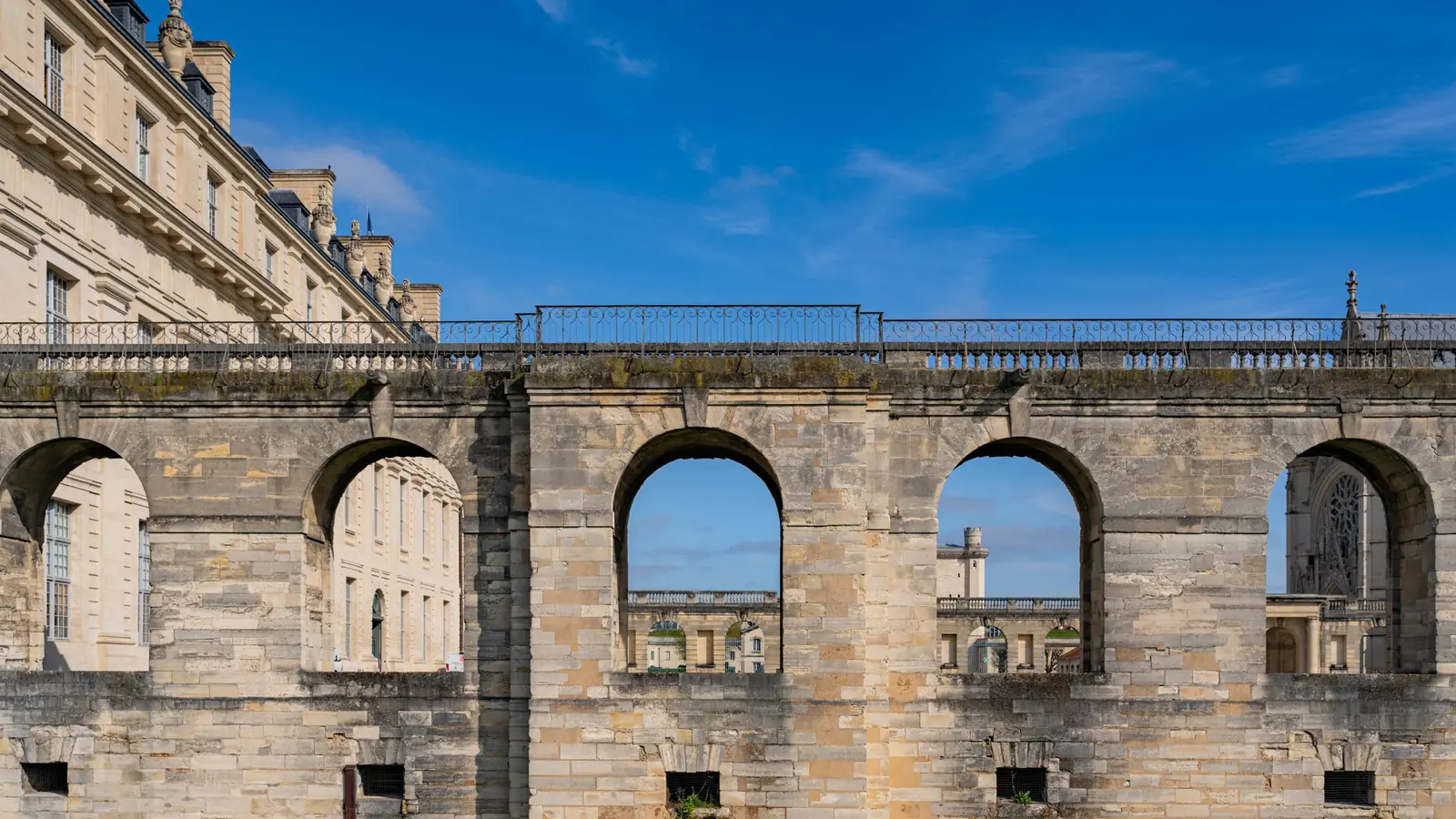
A royal manor made into Europe's tallest keep
Vincennes began as a royal manor in the woods east of Paris in the late 12th century, long before it was a fortress. Philippe VI had foundations dug around 1337, but the work stalled; after the Paris uprising of 1358 the future Charles V revived the project, and the tower rose from 1361 on those foundations. Charles V moved in around 1367–68, while building was still under way, and the keep was finished in 1369–70: 50 metres high, with walls more than three metres thick at the base, corner turrets, and an early, extensive use of iron bar reinforcement.
The chapel across the courtyard
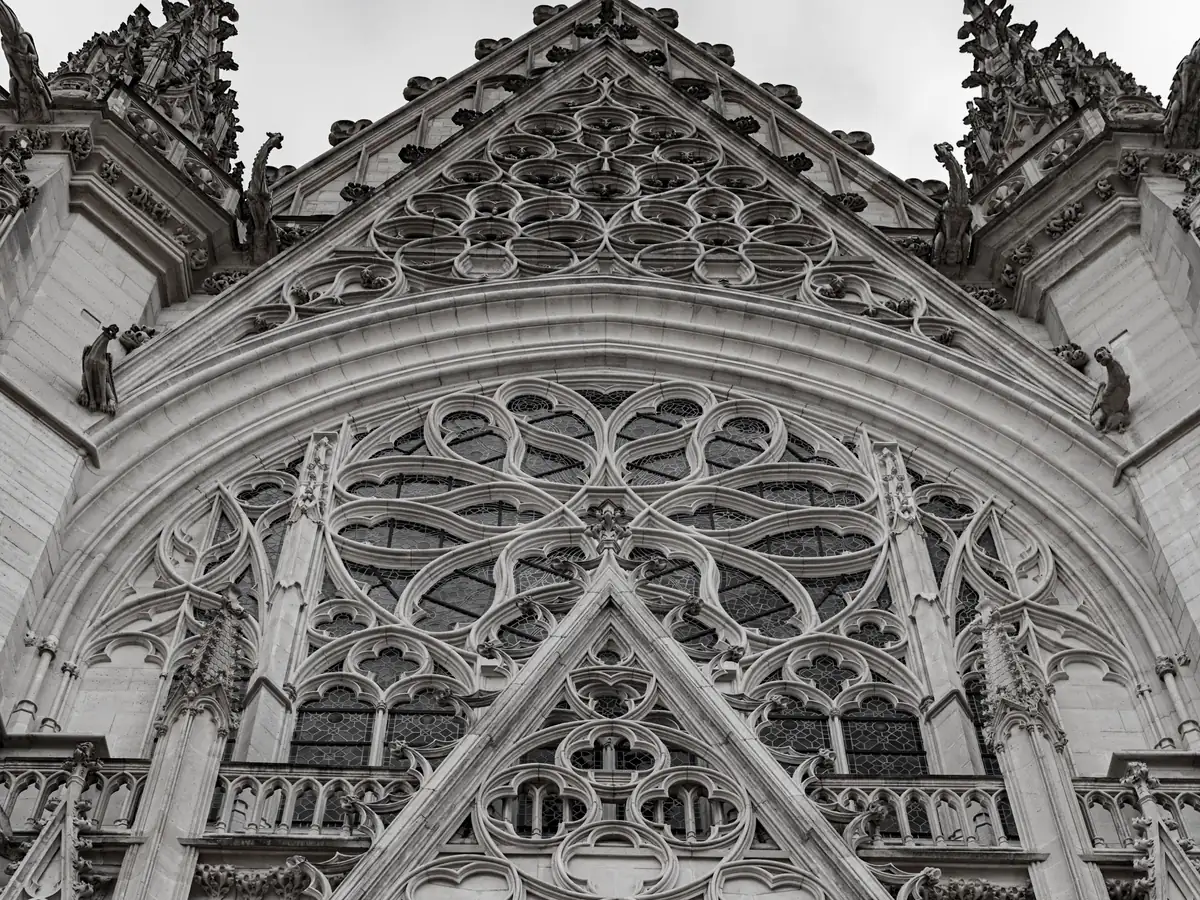
Charles V laid the foundations of the Sainte-Chapelle de Vincennes in 1379, modelling it on the royal chapel of the Palais de la Cité in Paris but on a single level. It took nearly two centuries to finish and was inaugurated under Henry II in 1552; its west front carries three gabled arches stacked one above the other around a rose window. Most of the nave glass was destroyed during the Revolution, but some of the windows around the apse, illustrating the Apocalypse, survive and were restored in the 19th and 20th centuries.
From royal seat to state prison
The keep held prisoners from the 15th century onward: the future Henri IV in 1574, Nicolas Fouquet in 1661, the writer Diderot, and, from 1777 to 1784, the Marquis de Sade and Mirabeau. Its use as a prison ended in 1784. The royal porcelain works occupied part of the château from 1740 to 1756 before moving to Sèvres, and under Napoleon I the site became an arsenal. The moat has its own darker history: the Duc d'Enghien was executed there in 1804 and Mata Hari in 1917. In 1939–40 the château housed the command centre of the French general staff.
A kilometre of wall, a dry moat, and the woods beyond
Beyond the keep, Vincennes is a complete walled fortress: a rectangular enclosure some 330 by 175 metres, its perimeter over a kilometre, ringed by a deep moat and originally punctuated by six towers and three gates. Most of those towers were cut down to the height of the walls in the 19th century; the Tour du Village on the north side is the one that keeps its full height. Step outside the gate and the Bois de Vincennes, the largest public park in Paris, runs on from there.
Plan your visit
Getting there
How to get to the Château de Vincennes from Paris
Métro Line 1 ends across the road from the gate — here's that route and the alternatives.
Open this guide →Inside the walls
What to see at the Château de Vincennes
The keep and the chapel are the two reasons to come — here's what's actually in each.
Open this guide →Comparing
Vincennes vs Fontainebleau: which one fits your day
A fortress a short Métro ride from the centre, or a palace an hour out: what actually separates them.
Open this guide →Timing
The best time to visit the Château de Vincennes
Which hours are quiet, which months fill up, and when the chapel glass is at its best.
Open this guide →With children
Visiting the Château de Vincennes with kids
A real moat and a tower to climb, plus a park next door for afterwards.
Open this guide →What to know before you climb the keep
Is this the château's own website?
No. This is an independent visitor guide and has no connection to the château or to CMN, the Centre des monuments nationaux, which manages the site and publishes its own visitor information at chateau-de-vincennes.fr. We link out to Viator for anyone who wants to book a tour or an entry ticket.
What are the keep and the Sainte-Chapelle, in short?
The donjon is a 50-metre keep whose foundations were laid around 1337 and which was finished under Charles V in 1369–70; the château's own site describes it as the tallest in Europe. The Sainte-Chapelle de Vincennes, across the courtyard, is the royal chapel Charles V founded in 1379, a Flamboyant Gothic building inaugurated under Henry II in 1552.
How do I reach Vincennes from central Paris?
Métro line 1 to its eastern terminus, Château de Vincennes, a short walk from the château, with no change needed from central Paris. The RER A also stops at Vincennes station, a little further away.
When is the château open?
It opens every day except 1 January, 1 May and 25 December, with longer hours from late May to late September. The Sainte-Chapelle also closes briefly around midday. Hours can change, so check the château's own website before you travel.
Can I go inside the keep?
Yes. The donjon is open to visitors and is the centrepiece of a visit, taking you up its stone spiral stairs to the council chamber and the king's own rooms.
Is Vincennes a UNESCO World Heritage Site?
No. It's a protected French historic monument, but it isn't on the UNESCO list. Its best-known feature is the keep, which the château's own site describes as the tallest in Europe.
What does this site actually do?
We write visitor guides to Vincennes — getting there, what to see, timing a visit — and link to tours and entry tickets listed on Viator. We don't sell tickets ourselves and we don't set Viator's prices.
Is Vincennes good for children?
Most families find it is: a real moat, towers and a keep to climb tend to hold children's attention better than a palace of state rooms. Children under 16 must be with an adult, pushchairs have to be left outside the château grounds, and the Bois de Vincennes next door gives them somewhere to run off energy afterwards.
Château de Vincennes on Viator
Shown in your chosen currency at Viator checkout; we add nothing on top.